
Every year, the Training Industry Benchmark Report gives us a snapshot of how training providers are operating, where learners are finding courses, and what’s changing across the industry.
Now in its tenth year, the 2026 report highlighted a few clear themes. Some trends continued from previous years, while others showed more noticeable changes in how training providers are approaching delivery, marketing, technology, and growth.
Spoiler alert, here's what we'll be covering in this article:
AI adoption has moved from “testing” to everyday use
AI is no longer sitting on the sidelines as something training providers are simply curious about.
"Is AI currently used in your organisation's training operations? "
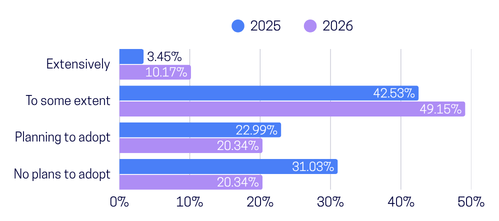
One of the clearest changes in this year’s report was the increase in providers using AI regularly within their operations. The number of organisations using AI “extensively” increased noticeably compared to previous years, while the number of providers with no plans to use AI dropped significantly.
What’s interesting is that most providers aren’t necessarily using AI in huge, transformational ways yet. Instead, adoption seems to be happening through smaller operational improvements:
- speeding up admin tasks
- improving reporting and analysis
- helping with marketing content
- reducing repetitive manual work
- supporting customer communication
The overall feeling from this year’s data is that AI has become more practical and less experimental.
For training providers, that shift matters. The conversation is moving away from whether AI will impact the industry, and more towards where it can save time, improve visibility, and support growth without adding complexity.
Search visibility matters more than ever
Search engines remained the number one way learners find training courses, accounting for around half of all responses in the learner survey.
Where learners find training courses in 2025
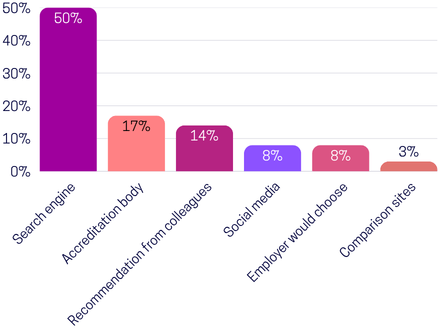
At the same time, recommendations and accreditation bodies continued to play an important role, showing that trust and reputation still heavily influence purchasing decisions.
What stood out this year, though, was the growing overlap between traditional search behaviour and AI-assisted discovery.
Many learners may still describe ChatGPT, Gemini, or AI Overviews as “search”, even though the way information is surfaced is changing quickly. That means training providers need to think beyond just ranking on Google in the traditional sense.
Visibility now depends on things like:
- publishing genuinely useful content
- demonstrating expertise clearly
- having structured, trustworthy website information
- maintaining strong accreditation and reputation signals
- answering common learner questions properly
The providers investing in educational, experience-led content are likely to be in a much stronger position as AI search continues evolving.
Classroom and in-house training remain incredibly important
A few years ago, many predicted that digital delivery would dominate almost entirely long-term.
This year’s report continued to challenge that assumption.
"Which types of courses does your organisation currently focus on?"
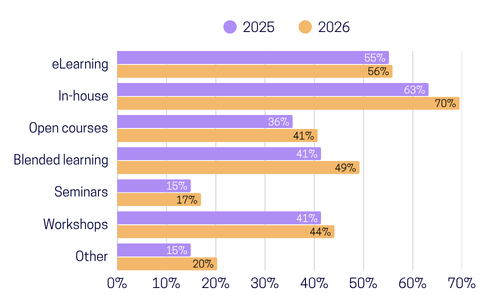
While online learning remains widely used, classroom and in-house training continue to hold a very strong position across the industry. In-house delivery remained one of the most common course formats offered by providers, reinforcing the ongoing demand for tailored and organisation-specific training.
At the same time, blended learning appears to have settled into a more realistic position after the rapid experimentation period of previous years.
The overall picture suggests that learners and organisations still place huge value on interaction, practical delivery, collaboration, and trainer-led experiences, particularly in regulated or skills-based training environments.
Rather than one delivery method replacing another, the industry seems to be finding a more balanced mix.
Operational efficiency is becoming a bigger competitive advantage
Across many of the comments from training providers, there was a recurring theme around pressure on margins, rising operational costs, and the challenge of managing growth efficiently.
That’s likely one reason why more providers continue investing in training management software and automation.
The providers performing well operationally are often the ones reducing friction behind the scenes:
- automating learner communications
- improving scheduling visibility
- centralising reporting
- reducing duplicate admin
- improving financial oversight
- giving teams better operational visibility
As training businesses scale, operational complexity increases quickly. The organisations that can maintain quality and learner experience without massively increasing admin overhead are likely to be in a much stronger position over the next few years.
Reputation still beats almost everything else
Despite all the discussion around AI, automation, platforms, and digital marketing, one thing remained incredibly consistent. Reputation and word of mouth continue to outperform almost every other marketing channel. That’s been a recurring theme in the Benchmark Report for years, and 2026 was no different.
"Which is your most effective marketing channel?"
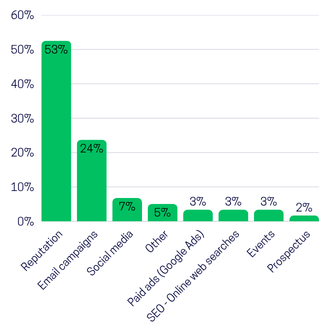
For training providers, it reinforces something important: marketing performance is often closely tied to operational delivery.
Strong customer experience, smooth learner journeys, high-quality delivery, reliable communication, and good outcomes all contribute to the referrals and recommendations that continue driving bookings across the industry.
Technology can absolutely support growth, but the providers building long-term momentum are usually the ones combining operational efficiency with consistently positive learner experiences.
Final thoughts
The 2026 Training Industry Benchmark Report showed an industry that continues to evolve, but not always in the ways people predicted.
AI adoption is growing quickly, search behaviour is changing, and operational efficiency is becoming increasingly important. At the same time, classroom learning, reputation, and learner experience still play a huge role in how training providers grow.
Perhaps the biggest takeaway from this year’s report is that successful training providers are balancing both sides well. They’re adopting new technology where it genuinely helps, while continuing to focus on quality delivery, trust, and long-term customer relationships.
You can download the 2026 State of the Training Industry Benchmark Report here!
-1.png?width=364&height=257&name=2026%20State%20of%20the%20Training%20Industry%20Benchmark%20Report%20(1)-1.png)
Want to learn more about accessplanit?
Book a demo and we’ll walk through the platform, talk through your setup, and answer any questions you have along the way.